The Third Treasure of Shaolin- Shaolin Kung Fu
The Third Treasure of Shaolin: Shaolin Martial Arts (Shaolin Kung Fu),
The Heart of Form, Energy, and Zen in Motion
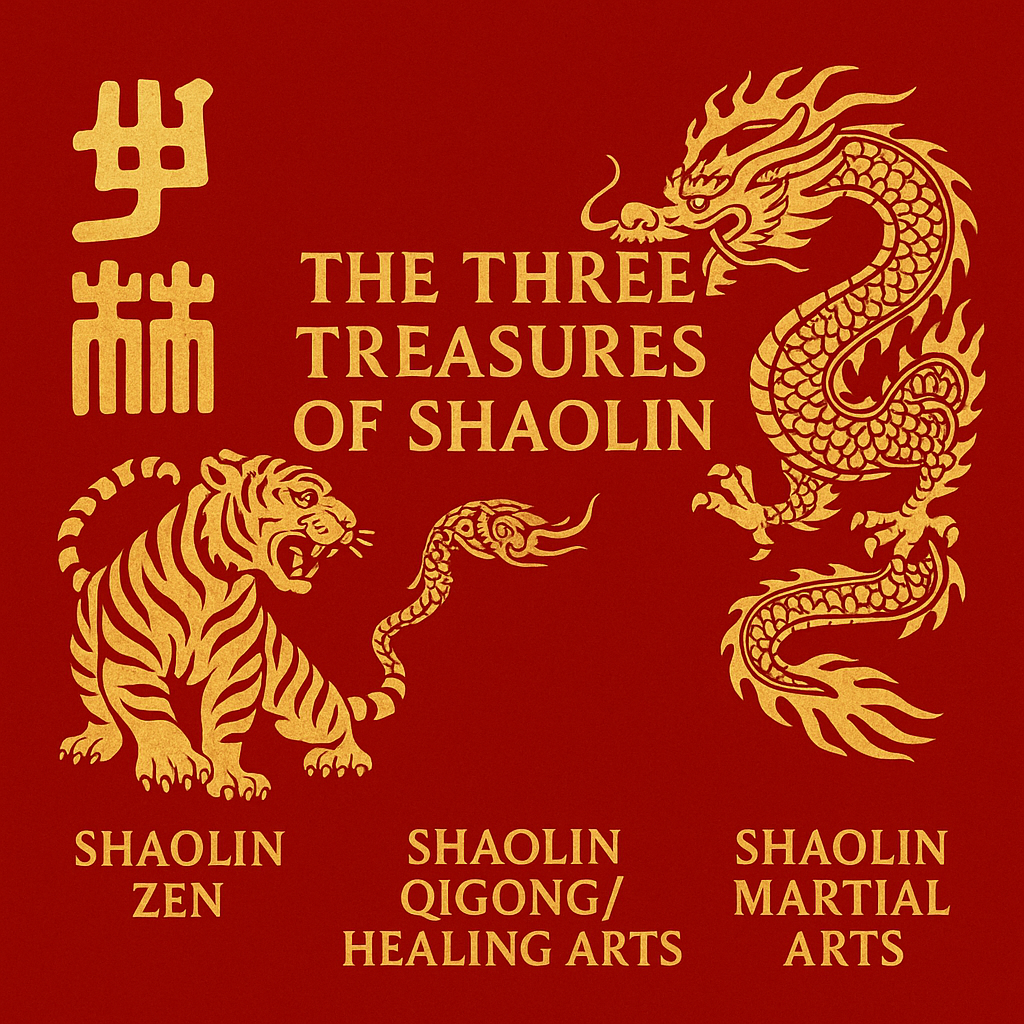
Shaolin Kung Fu — the Third Treasure of Shaolin — is often the first thing people imagine when they hear the word “Shaolin.” Dynamic movements, fluid steps, powerful strikes, graceful stances, disciplined conditioning, and classical weaponry all come to mind. Yet the deeper truth is that Shaolin Kung Fu is not merely a fighting art. It is the living expression of all Three Treasures of Shaolin woven together:
• Zen (Chan) – The First Treasure
• Qigong / Healing Arts – The Second Treasure
• Kung Fu / Martial Arts – The Third Treasure
In the traditional view, Shaolin Kung Fu is Zen, and Shaolin Kung Fu is also Qigong. All three Treasures interpenetrate, like three facets of one luminous jewel.
From the very first lesson — even before a student learns the name of a stance — they are already touching Zen, Qigong, and Kung Fu simultaneously. The integration is seamless, often subtle, but always present. This unified approach is one of the defining characteristics of Shaolin practice since the time of Bodhidharma (Damo), whose teachings shaped the spirit and methodology of Shaolin training for over 1,500 years.
The Three Treasures within the First Lesson
In authentic Shaolin instruction, nothing is isolated.
A beginner learning horse stance, bow stance, or the first stepping pattern is not just learning where to place the feet. They are learning:
• Rooting of body and mind (Zen)
• Breath regulation and energy direction (Qigong)
• Alignment, power, structure, and technique (Kung Fu)
Even when these elements are not explicitly explained, they are woven into the instruction.
The body learns.
The breath learns.
The mind learns.
The spirit learns.
This is why the Three Treasures are so inseparable — because in Shaolin, training is whole-person training.
The Philosophy of Shaolin Kung Fu
At its core, Shaolin Kung Fu is an art of:
• clarity of mind
• purposeful action
• compassionate strength
• balance and adaptability
• discipline without rigidity
• power without aggression
This classical Shaolin saying captures this unity:
“First cultivate the mind, then cultivate the art.”
Body, breath, and intention are not separate.
To punch is to breathe.
To breathe is to focus.
To focus is to harmonize with the present moment.
In this way, Kung Fu becomes a profound form of meditation in motion — Zen expressed through movement.
The Foundations: Body, Breath, Structure, and Flow
The basic and fundamental components of Shaolin training already contain the entirety of the art in seed form:
• Stances – stability, grounding, and structural integrity
• Hand shapes & techniques – precision, intention, and spirit
• Footwork & stepping patterns – adaptability, rhythm, and awareness
• Kicking & leg methods – extension of root and center
• Blocking & bridging skills – control, sensitivity, and timing
• Breathing – connection between inner and outer force
• Forms – living repositories of fighting wisdom
• Partner drills & sparring – compassion and discipline in relationship
• Weapons training – extension of mind-body unification
Forms and Fighting Application
Shaolin forms are often described as textbooks of movement, containing layers of:
• self-defense
• health cultivation
• internal and external power development
• strategy and adaptability
• martial philosophy encoded in motion
When practiced with proper intention, forms become a kind of embodied scripture — a teacher that reveals more as the student matures.
Fighting applications, such as bridging, trapping, chin-na, striking, kicking, grappling, or weapon application, all arise naturally from the principles embedded in forms. Nothing is separate.
The Shaolin Salute: A Seed Containing the Whole Art
My teacher, Shaolin Five Form Fist Headmaster Tao Chi Li (David J. Everett), taught us that the Shaolin Salute — standing tall, feet together, eyes forward, right fist joined to open left palm — symbolizes the Three Treasures of Shaolin in a single posture.
It represents:
• Strength with compassion
• Power harmonized with mindfulness
• Martial skill grounded in wisdom and peace
This gesture contains the entirety of Shaolin in seed form. It reminds the student that there is no separation between form, mind, movement, and energy.
They are simply different expressions of one unified path.
Lineage and Evolution: From Ancient China to Modern Times
Over the centuries, Shaolin teachings spread across China and eventually across the world, adapting to cultures, communities, and practitioners while still preserving the original principles of the Three Treasures.
Both of the systems I teach embody these traditions:
Shaolin Five Form Fist,
Passed to us through Headmaster Tao Chi Li, this system carries the deep classical structure of Shaolin — Tiger, Crane, Dragon, Leopard, Snake; as well as the stylitic expressions and arts of Northern Shaolin, Southern Shaolin, Quan-fa, Internal Styles, and Weapons; with arts of grappling and chin-na interwoven into all of the styles and systems — and integrates:
• powerful external techniques
• internal alignment
• breath, intention, and spirit
• classical footwork and animal energies
• Zen-based movement and awareness
Shaolin Butterfly Stylem,
A modern expression of ancient principles, the Shaolin Butterfly system embodies:
• transformation (the butterfly as the heart of the dragon)
• balance of softness and strength
• unity of movement and energy
• fluid circular footwork
• meditation in action
• the inter-relationship of martial technique, Qigong, and Zen
Shaolin Kung Fu in Daily Life
Perhaps the deepest teaching of the Third Treasure is that practice does not end when you leave the training hall.
Shaolin Kung Fu encourages the practitioner to:
• move with awareness
• breathe with purpose
• act with integrity
• cultivate compassion
• harmonize strength and softness
• embody stillness in motion
The Living Jewel of the Three Treasures
When we speak of the Three Treasures of Shaolin, we speak of one art with three expressions:
• Zen clarifies the mind.
• Qigong refines the energy.
• Kung Fu strengthens the body and spirit.
Together, they form a complete path of cultivation — a jewel with three luminous facets.
Shaolin Kung Fu, the Third Treasure, is the outward expression of the inner work of the first two. It is the visible flowering of roots that grow through Zen and Qigong. It is the way the practitioner interacts with the world — strong, centered, compassionate, awake.
“If you master one circle, have you mastered all circles?”
So it is with the Three Treasures. Each one contains the other two.
Each one leads to the whole.
Each one reveals the unity of the living heart of Shaolin.