

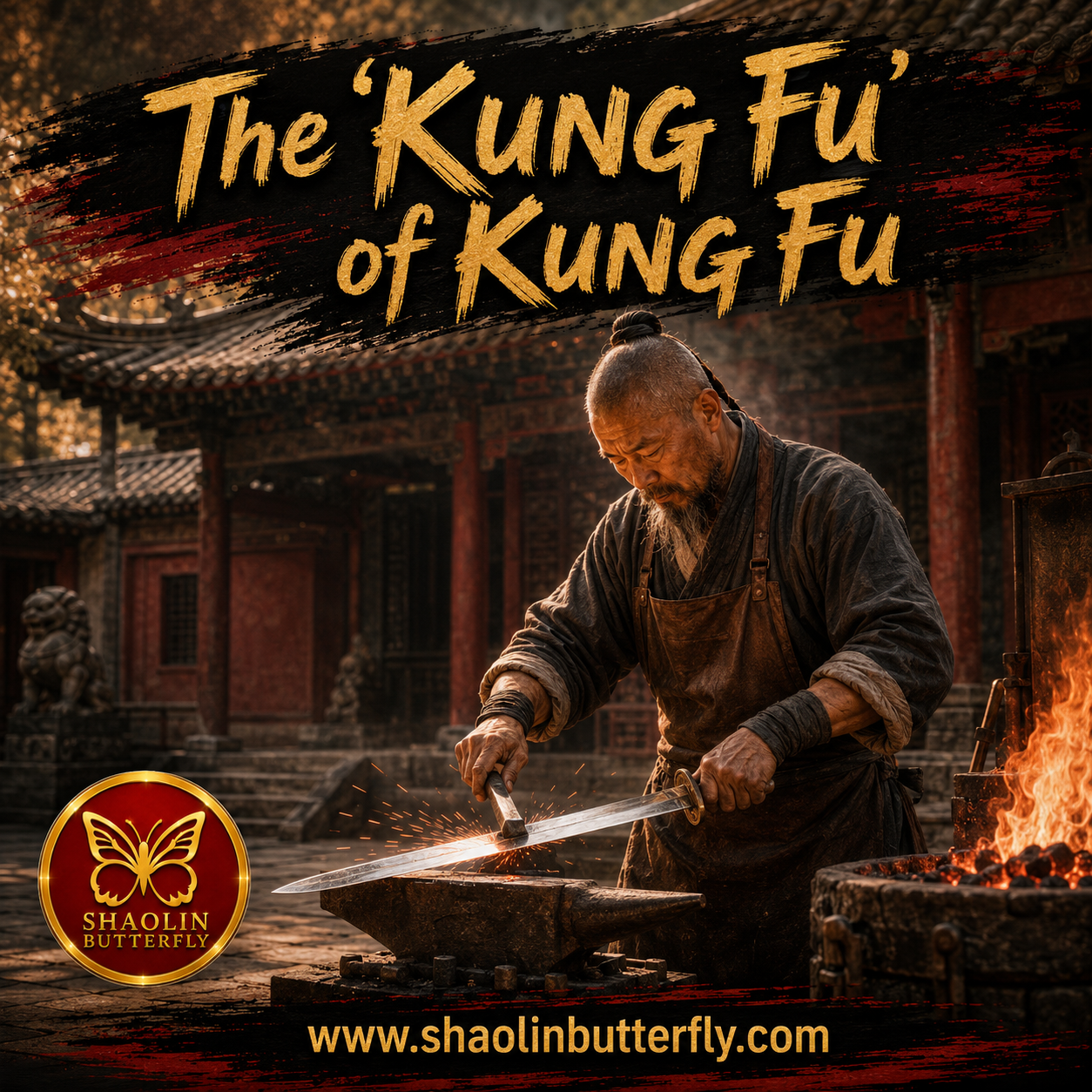
The "Kung Fu" of Kung Fu
Our teacher taught us the meaning of kung fu in countless ways, beyond the way we trained and learned the art in the kwoon. Many of those lessons came in daily interactions, both inside and outside the kwoon (our school, White Lotus Martial Arts Center).
As a true master teacher, simply being in his presence was itself a teaching.
He always presented himself to us as our teacher, and we always regarded him that way. We were not buddies, and never will be. He is my teacher, and our teacher. Even if I did not speak to him or see him for forty years, the moment we spoke again it would be exactly the same. This isn’t to say it was a cold relationship; far from it. It was just generally formal.
This was the level of respect he gave and expected, and it was something he modeled for us and expected us to model in our own way.
I am not talking about cult thinking or mind control. He was teaching us a true life art. Whether called Shaolin, T'ai Chi, or FMA/Kali, these are really arts of living and surviving. As he would often say, they are arts that help us survive and thrive within our own world and our own ecosystem.
Regarding kung fu, two examples really stand out.
He taught these lessons in every single class, regardless of what style or class you had with him. Right from the beginning, for instance, in the T'ai Chi classes he taught, he was emphasizing all levels of learning the art, but never in a confusing way.
There was almost a temple-like atmosphere, which was fitting for a school and system called White Lotus, though never in an overbearing fashion. It was warm, loving, and very much like an extended family. In the midst of the seriousness of training there was still joy and fun.
We were taught to regard kung fu as a great jewel, something to always respect and hold in reverence for the lessons it could give us and the ways it could help us in our lives. Again, this was never presented in a heavy way, but rather to impress upon us the importance of the art, and it’s depth, beauty and ultimately sacred nature.
One of his favorite metaphors was to compare "the Art," as he called his arts and the martial arts in general, to a buried treasure.
This treasure was unlike any other, because when you dug for some of it, you discovered that the more you dug, the more treasure there was.
It was limitless.
There was always more.
In much the same way he taught, the more effort you put into the Art, as in practicing and living the lessons and ideals of the art in daily life, the more it gave back to you. The more and deeper you dug, the more treasure you found, the more you give the art, the more she gives back.
It was almost as if digging for treasure was like putting fertilizer on weeds, except instead of weeds you got more treasure.
This is a perfect metaphor for understanding both the benefits of practice and the importance of practice. The Art gives back in direct proportion to what we invest in it, helping us, as he often said, to survive and thrive in life.
Another memorable lesson came during the two years when I delivered bottled water throughout Connecticut, Massachusetts, and Rhode Island.
At the time, this was the perfect job for me because all I wanted to do was train.
I took every student class I could and every instructor class I was allowed to attend, six days per week, studying all three of my teacher's complete curricula simultaneously: Shaolin Five Form Fist, T'ai Chi, and Filipino Martial Arts.
I was a true kwoon rat.
I was generally the first one at the school and the last one to leave. My teacher often had to throw me out at night, saying, "I have to go home and see the wife!"
The work delivering bottled water itself became part of my kung fu, T'ai Chi, and kali training, including driving the vehicle—all of it.
Every Wednesday morning I delivered water to Westover Air Force Base in Massachusetts. It was my first stop, planned that way, carrying nine or ten five-gallon bottles up thirty-eight flights of stairs to the top of the flight control tower.
I carried them up two bottles at a time, one on a hook in my right hand and one on my left shoulder, one hundred pounds altogether. Then I ran down and got two more to carry up, up and down I’d jog till their delivery wa complete.
I would stretch briefly and then lightly jog up the stairs when I arrived and began bringing them their water delivery, often passing the flight control officers on their way up from smoking a cigarette, all out of breath. I'd say, "Good morning, Officer!" as I passed them on the way up, jogging with one hundred pounds of water in tow. Yes, I could be a wise-ass at times. I meant it, but I got a kick out of it at the same time.
At our school I installed a water cooler in the lobby that my teacher kept flavored with a special Chinese herbal blend, no kidding.
One day the bottle needed changing.
He sat quietly at the desk and watched me remove the old bottle, unwrap and lift the new one, and pour it into the cooler without spilling a drop, using the body mechanics he had taught me over the years.
When I finished, he calmly began teaching.
He often defined kung fu as "high skill gained through time and effort."
He explained that I had developed "water bottle kung fu."
I listened carefully, because with a teacher like him every word mattered. Every lesson mattered. Tying his shoe could become a lesson. His every step and every breath was a lesson, potentially. In our arts we were taught to pay attention, often called meditation. And pay attention I did, so much so that my lineage name is Dao Chan I.
He explained that the same process which had allowed me to develop skill in carrying and working with water bottles could be applied to almost every aspect of life.
This process of kung fu was there to help us improve ourselves and thereby also to help others, however that might work for us. By being polite, respectful, and kind, for instance, we are helping others. We might not all be like Mother Teresa, but still, we can make positive contributions, and that is also part of kung fu, its fruit, so to speak.
I remember that water bottle kung fu lesson as if it happened yesterday, though it probably took place over thirty-five years ago.
Our teacher was definitely from the old, old school. Learning kung fu from him was not always enjoyable or thoughtful; it might be excruciatingly painful as well, and often was, sort of like playing full-contact American football, but worse! And I mean that, having gone through both football and wrestling ‘hell week’ in school- every class could be an incredible, and painful, lesson and journey, depending on the class one was in (T’ai Chi was generally less severe, but try standing in a posture for an hour and you will find it isn’t always so pleasant, either).
But that painful part—"eating bitter," as it is called by many—is also part of the kung fu process of life for all of us at some point. It isn’t always sweet. So this painful kung fu training is still good training for those who are ready, willing, and prepared to handle it.
So truly, with kung fu there were no shortcuts.
There are still no shortcuts.
And as our teacher emphasized, kung fu is not simply martial arts. Kung fu is a process which can be applied to all of life and so many aspects of our lives, and in fact should be; otherwise our kung fu digging will remain shallow and we will receive only a little treasure.
Now, part of the process of kung fu is also maintaining balance and harmony. Rest, food, sleep, family, friends, work, and the support of and interaction with others are all part of the process.
The treasure is limitless, so there is no need to exhaust ourselves trying to dig it all up at once.
The important thing is that the digging never ceases.
And as we were taught, kung fu is something we must practice every day of our lives until the day we pass on from this mortal vale.
Highest respect to our teacher for always, without fail, teaching us patiently, and at times not so pleasantly.
Shaolin Butterfly
Ancient Arts For Modern Times
Balance • Harmony • Wellness • Longevity
Sifu Michael Fuchs
www.shaolinbutterfly.com
** dedicated to Tao Chi Li and all of the teachers of the Way.
**** FOR THOSE WHO WANT TO DIG SOME MORE, COMPILED BY PERPLEXITY A.I.:
The Meaning of Kung Fu: More Than Martial Arts
When most people hear the phrase kung fu, they think immediately of Chinese martial arts. That is a fair association, but it is also a limited one. In Chinese, 功夫 reaches far beyond fighting: it speaks to skill, mastery, patience, discipline, and the long process of earning ability through sustained effort.[dictionary.writtenchinese]
The deeper meaning is what gives the term its power. Kung fu is not something you merely possess; it is something you build through repetition, perseverance, and time. That idea is central not only to martial training, but to craftsmanship, study, and any serious human endeavor.[stlkungfu]
The Characters Themselves
The first character, 功, carries the sense of achievement, merit, accomplishment, and effective work. It is the character of results earned through effort, not of luck or shortcut. In the interpretation emphasized by Sifu Moy Yee, it reflects labor and strength, which fits the broader idea that real skill comes from application and endurance.[en.wiktionary]
The second character, 夫, has a longer historical life. In older Chinese, it could mean man, husband, or adult male, and it has also been explained visually as a person bearing a burden. In that reading, the character contributes a striking image to the compound: a person carrying weight through time, which mirrors the discipline required to achieve true mastery.[etymologist]
Taken together, 功夫 does not literally mean “martial arts.” Instead, the compound points to the human process behind achievement: work, patience, and cultivated ability. That is why the word can apply to almost any area of life where expertise must be developed rather than simply claimed.[hsktracker]
Why the Word Became Martial Arts
In modern English, “kung fu” usually means Chinese martial arts, and that usage is now widespread. But that is a narrowed popular meaning, not the full semantic range of the Chinese term. The martial-arts sense grew naturally because traditional Chinese fighting systems demanded exactly the kind of long-term training the word already implied.[britannica]
That shift in English is historically important. According to the discussion on Sifu Moy Yee’s site, the Western association became especially widespread after Bruce Lee’s international fame, which helped the term “kung fu” become a global label for Chinese martial arts. Even so, the Chinese word itself remained broader than the English popular usage.[dictionary.writtenchinese]
What the Tradition Emphasizes
Sifu Moy Yee’s explanation does something especially valuable: it reframes kung fu as a principle of life, not just a fighting method. The point is not simply to look skilled, but to become skilled through honest effort, patience, and persistence.[moyyeehopvingtsunkungfu]
That emphasis is echoed by STL Kung Fu, which describes kung fu as something measured by what you can do with it, with practice as the core secret. That teaching style reinforces an important truth: kung fu is real only when it becomes usable, embodied, and tested over time.[stlkungfu]
The same idea appears in the broader martial-arts context as well. Kung fu is often understood not only as a combat system, but as a discipline that develops self-control, calmness, and composure under pressure. In that sense, training becomes a method of shaping both the body and the mind.[britannica]
The Most Useful Way to Understand It
The cleanest English rendering of 功夫 is something like earned mastery through sustained effort. That phrase captures both the practical and philosophical sides of the term. It explains why kung fu can refer to martial arts, but also to skill in cooking, writing, music, or any craft that demands dedication.[kungfutoday]
So when someone uses the word in a traditional sense, the key idea is not violence or spectacle. It is the slow, disciplined process by which ordinary effort becomes extraordinary competence. That is the heart of the word, and it is why kung fu remains such a powerful expression in Chinese culture and beyond.[dictionary.writtenchinese]