

The Five Pillars of Shaolin
The Five Pillars of Shaolin
A Living Structure Within the Three Treasures
In the Shaolin tradition, nothing stands alone.
The arts are not fragments. They are living systems — layered, refined, and preserved through lineage. Over time, I have come to understand that two great frameworks guide my training and teaching:
The Three Treasures of Shaolin
The Five Pillars of Shaolin
Together, they add depth, structure, and precision to everything I do — whether I am teaching martial arts, writing, working with special needs populations, or simply navigating daily life.
These teachings are not theories to me. They are inherited responsibilities — gifts I was blessed and honored to receive.
The Three Treasures of Shaolin
The Three Treasures form the classical trinity of the Shaolin path:
Zen (Chan) – The First Treasure
Calm mind. Spiritual clarity. Inner stillness. Wu and Jianxing (kensho and satori).Shaolin Qigong / Healing Arts – The Second Treasure
Cultivation of energy, breath, vitality, and harmony.Shaolin Martial Arts – The Third Treasure
Skillful expression through movement, technique, and disciplined action.
Zen steadies the mind.
Qigong nourishes the energy.
Martial Arts expresses both in action.
Without the Second Treasure — Qigong — the body has no true root, and the martial arts have no depth. It is the bridge between stillness and expression and support all else.
The Five Pillars of Shaolin
The Inner Architecture of My Teacher’s Art
The Five Pillars are an essential element of the foundational structure of the system preserved and passed on by my teacher,
Lao Shr Tao Chi Li (David J. Everett) — the Headmaster of the Shaolin Five Formed Fist system.
This is a traditional martial arts system in the lineage of Shaolin and the famous Central Nanjing Goushu Institute, preserved within the Koushu Federation, R.O.C., and passed through an extraordinary lineage that includes:
Wu Jen Dai – a pre-Revolution Shaolin Grandmaster who later settled in Taiwan (R.O.C.)
Dr. Daniel K. Pai – with whom my teacher lived with in Hartford at the H.Q. school as live-in disciple and Chief Instructor of the Pai Lum system in the 1970s, Founder of the USA Koushu Federation and a V.P. of the International Koushu Federation, R.O.C. (among many other appointment and achievements)
My teacher trained with many other well-known and lesser-known masters of remarkable depth and skills, including from the Koushu Federation, world-wide
I also bow in gratitude to Dr. Maung Gyi, a living legend whose scholarship, depth of knowledge, awesome skills and breadth of vision helped me widen my understanding of the arts at deeper levels.
The Five Pillars are:
Health of Mind and Body
Fighting Techniques
Fighting Psychology
Internal Principles
Spiritual Growth
Each pillar is subdivided into five categories.
Each category subdivides again into five more sub-categories.
This is not accidental. It is classical structure — precision layered within precision.
Pillar One: Health of Mind and Body
An Evolution of the Second Treasure
If the Second Treasure of Shaolin is Qigong and the healing arts, then Pillar One is its structured expansion inside a complete martial system.
It includes:
Strength
Weights
Dynamic tension
Tempering
Meditations
2. Flexibility
Cat stretch methods
Willow methods
Bamboo methods
Two-man stretches
Breathing
3. Diet (this includes herbs)
4. Meditation (including qigong)
5. Immunity to Disease
This is not “fitness.”
This is cultivation.
Notice how clearly this mirrors the Second Treasure:
Breath and energy
Internal harmony
Healing and recovery
Longevity
Balance
The Second Treasure teaches us to cultivate life-force.
Pillar One organizes that cultivation into a precise, living curriculum.
This is lineage evolution — not departure.
The treasure becomes architecture.
The principle becomes system.
The medicine becomes method.
Why This Matters Beyond the Martial Arts
These structures shape everything I do.
They influence:
How I write and teach
How I work with special needs populations
How I approach healing arts
How I think through problems
How I guide others through transformation
Depth Through Lineage
We live in a time when information is easy to access — but depth is rare.
Lineage does not mean imitation.
It means preservation with understanding.
It means honoring those who came before:
The pre-Revolution Shaolin masters.
The teachers who carried systems across oceans.
The scholars who clarified theory.
The quiet instructors who passed on their arts without recognition.
I bow to my Headmaster for preserving and passing on this great system.
I bow to Dr. Maung Gyi for widening my technical, intellectual and cultural vision.
I bow to all the teachers — named and unnamed — who carried the flame.
Without them, there are no Pillars.
Without Pillars, there is no structure.
Without structure, depth collapses.
The Living Integration
When Zen steadies the mind,
When Qigong nourishes the energy,
When Martial Arts expresses disciplined action —
And when the Five Pillars organize health, technique, psychology, internal principles, and spiritual growth —
Then the art becomes whole.
Calm mind.
Balanced energy.
Skillful action.
Structured cultivation.
Spiritual direction.
With gratitude and humility,
I continue the training.
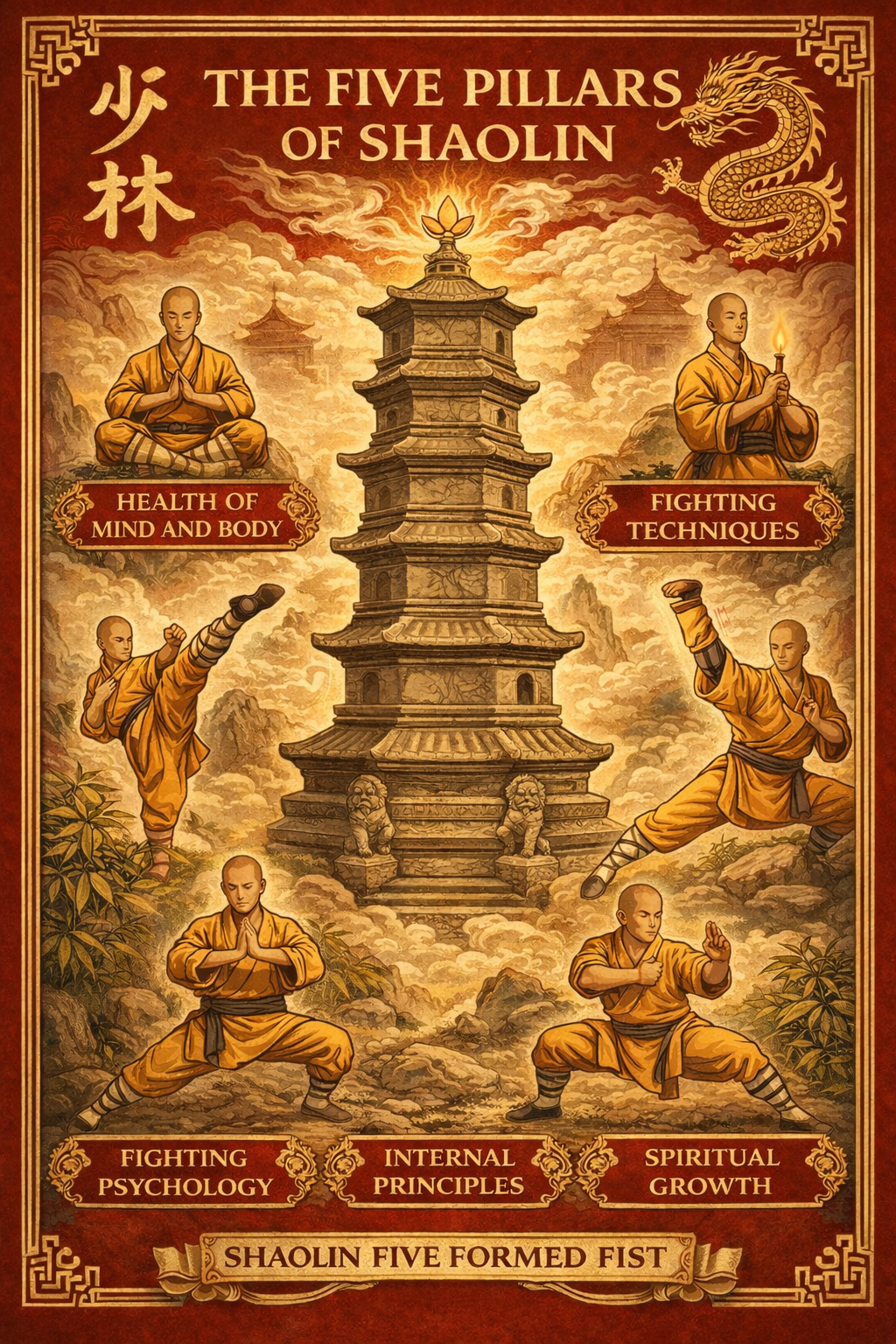
THE FIVE PILLARS OF SHAOLIN